
44~Self-Permission. Guilt and Other Herbs.
- Nov 13, 2025
- 12 min read

The anguish of not knowing has tormented me for a long time. I have felt too flawed, too alone, too mistaken, too lost, and all that multiplied by a thousand, for many years. It was only in India that I began to see that there are many “others” who have the same questions. That there are many others who have also stepped outside the parameters of what we interpret as “normality,” who have explored other paths, who have felt disillusioned, who have been frustrated too, and who, after all that, simply stepped aside. That there are many beings who choose new perspectives through which to walk reality—neither better nor worse, simply different. That also existed, and perhaps it was obvious, but I hadn’t truly seen it as possible until now. Probably my eyes and my mind had needed that time to “ripen it.” Probably society and its mandates had indoctrinated me as well as everyone else. All of them have shown me that other ways of living are possible.
In Asia I found parallel universes, many different tribes, and I began to understand that we can also choose which one we want to belong to.
Yes, I’ll repeat it: WE CAN CHOOSE WHICH ONE WE WANT TO BELONG TO.
And on an even more essential level: We can choose.
For that, we must give ourselves permission. And it sounds simple, but anyone who has already walked this path of “giving herself the things she needs” knows that it isn’t so easy. Yet when it happens, it’s an act that—fortunately—often has no way back.
Once you discover freedom, you don’t lock yourself inside a cage so easily again, even if the bars are covered in glitter and colorful paper.
At least not for something that isn’t truly worth it.
Despite my traveler’s life, my rebellious style, and my open mind, I still had the mindset of productivity and social mandates deeply planted in my brain. Even though I had long since moved away—light-years away—from a “traditional” life, somewhere deep inside I was still longing for that traditional life. In reality, what I probably wanted was for a traditional life to be enough for me, because it looks like an established, predictable, and proven recipe. The problem is that even when I tried—because I swear I did—it wasn’t enough, and fighting against that made me feel even stranger, more broken, and more flawed.
Are we really who we want to be?
Are we really who we “choose” to be?
Those who are more connected to reincarnation, past lives, and ancient Eastern traditions say that our soul chooses the body where it wants to reincarnate—the container. In the same way, we also choose the souls of those who will be our parents—our facilitating environment and our teachers—even when our mission is to transcend them.
From this perspective, we come into this life to learn something, to fulfill the purpose our soul needs in order to keep evolving along its own path of evolution. So the coordinates and figures of those who will accompany us in that process are crucial and not random. Of course, all of this is forgotten, and perhaps from there we can reformulate whether we truly “choose” consciously what we want in life.
Are we really the ones steering the ship 100%, or are there deeper threads that somehow exist before our will, before our conception as body and matter?
My father always said that life is like a train—that we can get on and off, linger at a station, change seats or even wagons. Stop, and even return to the same place—but sooner or later, we’ll arrive at the place we are destined to reach. No matter what you do, what is yours also chooses you, also finds you—and we’ve all heard those incredible stories of connections and strange, implausible coincidences that seem impossible, that make no sense, and yet, they exist. That is the substance my soul lives on. And if you haven’t heard them, I hope somehow I can make them reach you, because it is precisely there where all the magic of life hides.
And so, in the end, there is nothing to chase: what is meant for us will arrive exactly when it must—neither before nor after—just make sure you have enough faith so that, when it comes, it simply happens.

I don’t think it’s a coincidence that my soul chose exactly the parents I chose. With their successes and their mistakes, and from this perspective, they would no longer be “mistakes,” but simply conditions to shape the reality I was predestined to, and that, based on my choices, I needed. My father, a great sage. My mother, a warrior and a survivor: free, independent, and infallible.
Both, in their own way, provided the coordinates needed for me to be here today doing exactly what I am doing now. My father gave me infinite wisdom, my mother strong wings and the necessary detachment to go fly.
Nothing, nothing, nothing is a coincidence, and being able to perceive it this way subtly changes the color of everything and empowers us.
For a long time, I felt that these ideas clashed quite a lot with my mind as a psychologist. Now, I believe they actually make more sense than I had thought. Some time ago, I befriended the word integration. Now I just try to let both ideas coexist together, and let each find its own place.
How? I’m still figuring it out, but for now, simply like this: allowing them to coexist at the same table without invalidating each other.
I don’t know if everything makes sense all the time.
My psychologist used to say that sometimes life is also about enduring the meaningless.
I like the word permission. I think it’s an interesting way of thinking to allow at least new possible states, new possibilities, even when we don’t fully understand what they mean.
Permission is freedom itself, the potential for something to exist.
Yes… the more I think, the more philosophical I become.
That simple little word, which seems so easy and childlike: Permission. Permission is what I realized I almost never gave myself.
Trivial permissions, of course. Those that are easy, instant, tempting, and addictive. Of those, yes, all of them, in excess and as a banner. Taking a beer—two, three, fifteen—permission to go out, to smoke, to do, to try, to sleep; even permission to stop from time to time… but not deep permissions: permission to let myself feel whatever I needed to feel from the depths of my soul, for example, or permission to be, and permission to not be as well.
Permission… Crucial.
During my life, I had given myself countless “permissions,” yes, probably far more than most people usually give themselves.
As a teenager, I played the drums in a rock band with friends. I lived with my boyfriend in a house where we had built our own musical studio and we rocked at least five times a week, among beers, gatherings, and barbecues. I had a laid-back, impulsive, rebellious life full of rock, concerts, hippie vibes, and excesses. With my father’s help, I had set up a workshop to weld and polish metals in my own home. I took a year off from my career to fulfill the dream of being a craftswoman and making alpaca jewelry. I sold it every weekend at the fair in Buenos Aires. Among all that, several times a year I would go backpacking, camping, and hitchhiking through the corners of my beautiful country.
I also danced, studied gem therapy, and had thousands of other hobbies. Yes, you see that you’re not talking to someone too conventionally adapted to society, nor too static, nor too conformist. And yet, I repressed a lot of things.
Before arriving in India, I had left Argentina five years earlier. I had lived in several countries, in many different homes, with many different people. I had left behind my conventional life, my profession, my work, my home, my family, my country. I had worked in many jobs I had never imagined, and my hours and routines were somewhat stranger than those of most people, yet at the core of mandates, I carried the same “not being” guilt as everyone else. And probably now with more weight, because not only had I not achieved them, but on top of that, I had broken them.
Guilt is something you carry with you, wherever you go, wherever you move. It’s like an internal sticker you carry on the back of your forehead—or right there, stuck to your heart—and since I was a child, I carried several of those. And it’s interesting, because guilt doesn’t raise our energy; however, it makes us move in directions we never would have thought of, and most of the time, we don’t even want to.

Tiruvannamalai, India
What were these guilts, and what form did they take?
Well, I’m an only child. My mother is also an only child, and my father was distanced from his entire family, so my family nucleus was always very small. For a long time, it was just me, my mother, and my father.
They had separated several times since I was 7 years old, and neither of them had formed a family again, so the weight of my parents’ well-being had always been a theme in my life, since I was a child. Probably, even if we aren’t only children and even if our families are not small, the family burden will always be one of the BIG issues in our lives, and also in therapy sessions—if you’re lucky enough to have that space for family vomiting.
So those were the cards I was dealt, a bit scarce and without much variety.
My father had passed away 8 years earlier. We had a relationship of confidants, too close, too beautiful, too deep. But sometimes, like everything intense between two people, it also became heavy. When my father left, I thought I would never get over it—that was the terror I had dealt with my entire life—but paradoxically, and thanks to all the love he had taught me, I went through it. It was extremely hard, of course; I grieved many times, with many rituals along the way and in several different places, but in a way, I felt that with his physical departure, somehow my father had freed me.
We both knew it. If my father hadn’t left, I probably would have never left Argentina, I would have never let go of him, and if I say let go, it’s because, in a way, I felt responsible for him, and that—for us children—is far too much, far too much responsibility. Proportionally, also, the task that many children take on mistakenly.
After he passed, I felt the freedom to go out into the world and pursue my dreams. Now I was free; nothing tied me anymore.
The relationship with my mother had always been different, more distant and conflictive, like typical mother-daughter relationships. She had a more solid, established, and independent life, but you see, even that doesn’t save us from the feeling of not occupying “the place we should be occupying.” So, suddenly, the weight of taking care of my father had disappeared—at least on the physical and practical level—but now I started to carry all the maternal guilt.
Until that moment, I had never experienced it, but when your hands are free and you’re used to holding, it becomes very easy to swap one object for another. Even if no one asks us, even if we complain, even if our hands hurt—and our back too—we go ahead and do what comes “most naturally.” There we go, like Little Red Riding Hood entering the forest, jumping happily with her basket from side to side, facing the Big Bad Wolf. And it’s interesting, because in the end, the key isn’t specifically in the person or the role she occupies in our life, but in our addiction and in the habit in our own pattern of action.
Our familiar response, what we “usually do.”Probably what we hate, but what we usually do.
Yes, that smart we are (LOL).

Winter time in Dharamkot, India.
Our uncomfortable comfort zone… And careful, because anyone can take that place. The partner is the one holding the next number in our bench of substitutes, waiting for us to move just one finger so they can run onto the field and play the next match.
And well, the ending was somewhat predictable. That pressure –or need– to hold up the other was like a giant magnet I held in my hand, and all the guilt related to my mother was just waiting to stick to it, like little colored metal balls.
“You left and abandoned her alone…”
Whose fault was it?
Whose hand was holding the magnet?
If there’s something I’ve learned over these years, it’s that we always choose, even when we think we don’t—and that’s the end of the story, and also the beginning of the new book.
Going alone to India was, in some way, starting to leave behind –even further behind– everything that didn’t belong to me, because in the end it’s not a matter of physical distance but a matter of positioning.
Going alone, and with no one knowing about it, was symbolically beginning to take responsibility for giving everyone back what belonged to them, and also acknowledging that I had both the right and the responsibility to think of myself –and above all, the responsibility. That I also needed to be a little selfish –if we understand that as consciously taking responsibility for our desires, our happiness, and our own being, caring for, valuing, and respecting who we are in the most balanced way possible toward ourselves, without ceasing to think lovingly of others– and that this is what’s healthy.
In fact, linguistics supports it, because it’s no longer called selfishness; it’s called self-love.
–“And your mother? Is she alone in Argentina?” –“Yes… and I’m alone here… so what?... What should I do? Change my life and my direction just so she’s not alone? Go play the role of ‘chaperone,’ hold the candle for her while at the same time throwing my own dreams in the trash?”
Yes, I know it sounds like I’m jumping at someone’s jugular with that answer, but people have no idea how heavy those questions become when all you’re trying to do is sort out your own life in the best way possible, in your own direction.
These were the answers of a more evolved me, already with quite a bit of maturity and a long personal process behind her. It took me a lot to conquer that place.
Actually, it was something my psychologist used to tell me through many different examples while I cried, rolling around in my own tears of guilt. And for a very long time, I only reproached myself for leaving my mother alone.
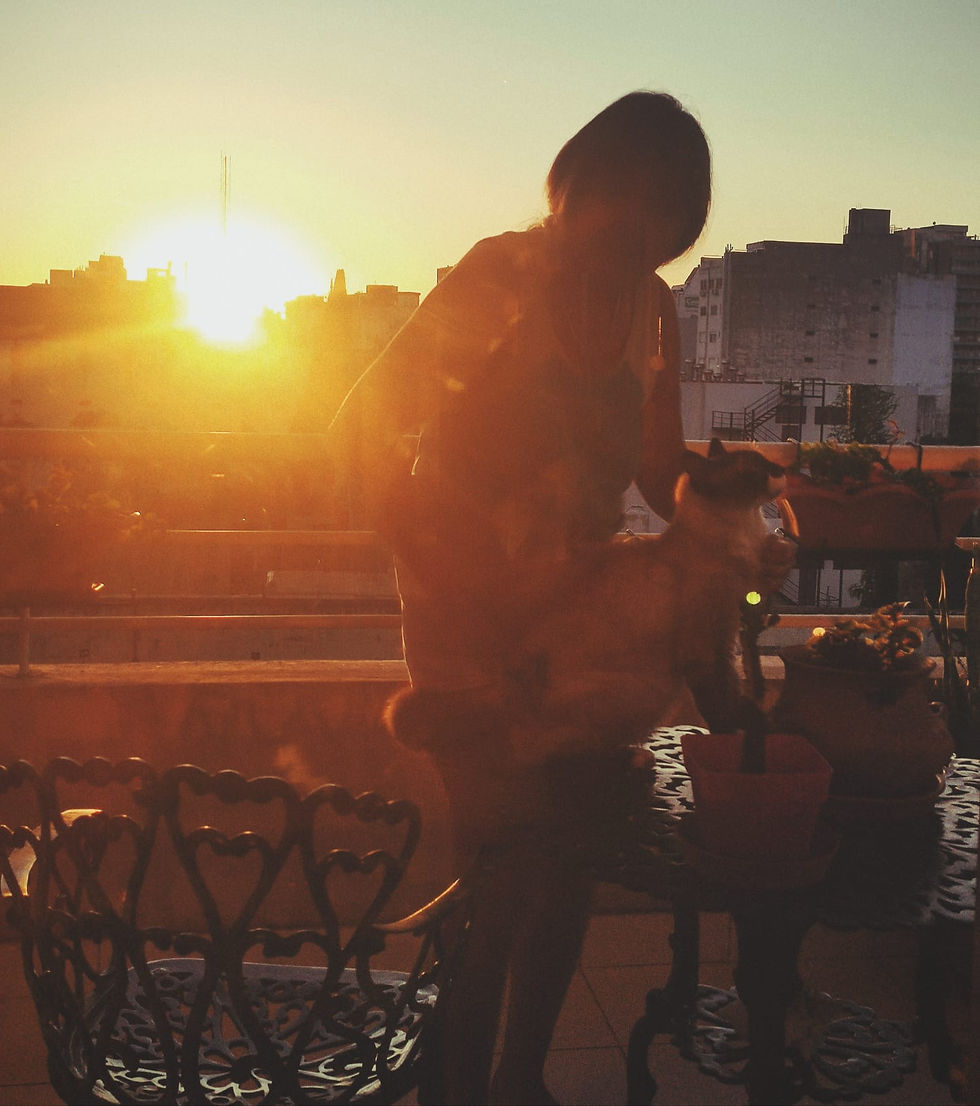
Do they think it’s easy to leave? To be far away?
Do they think that with a one-way ticket you automatically get a free insurance that numbs your heart and turns you into ice?
Distance isn’t easy. Taking responsibility for making your own life far from home isn’t either, but when you realize it’s the only possible way to be happy because that’s what your body feels, it becomes almost a duty and an obligation.
You leave many things behind. Sometimes it’s not even a choice but simply the direction of your own path, and being able to understand that requires a certain maturity and also courage to face reality.
Neither side is simple—the one who stays nor the one who leaves. The seal applies to both sides of the equation in different ways.
It’s not always how we want it to be, but at the end of the day it’s all there is, and part of life is learning to look both ways with deep love—not only toward what we leave behind, but also toward what may come from it.
Needless to say, a great part of my journey wasn’t really about India, but about learning to take charge of my own life, and that’s where I discovered that I had a huge task ahead of me that had been somewhat neglected: my own dreams.
My happiness was as important as my mother’s, but in practice, my own happiness was the only task that truly belonged to me. I don’t know if I ever had the full capacity to make my mother happy –I think carrying someone else’s happiness is something we tend to do, but it’s a very difficult task that we should question–, yet I was surely responsible for making myself happy, because that’s what we come to life for, isn’t it?
A large part of my personal therapy had been about how to make my parents happy and how to wash away my guilt –like everyone, or like many of us...Good child, beautiful and altruistic, but quite a heavy task for a mortal… and guess what: in the end, it never truly works—not entirely for them, nor truly for us.
The only happiness depends on oneself, and I don’t know if I could teach that to others yet, but at least I had to start practicing it myself.

Koh Panghan, Thailand
No one can make another person happy if they don’t make themselves happy first.
How often we hear these ready-made phrases, right?… What I realized over time is that there comes a day when these iconic, memorable, and epic sayings finally make sense, and suddenly they touch your soul. And it’s not because you’ve heard them too many times, but because after so many repetitions and lived experiences, the insight arrives, and that moment is magical: it’s when you finally understand.
The phrase only reaches your body when you have the right level of awareness to comprehend it. Not before, not after.
Like when a psychologist makes an intervention, or when a best friend tells their best friend something that’s obvious but the other isn’t yet ready to see or hear. How many times, as a psychologist, have I reached eloquent, masterful, personal conclusions—accurate, coherent, and precise, the kind that make you want to applaud yourself. How many of those comments have ended up in the hole of the strainer, as Lacan would say, passing so unnoticed by the subject that they didn’t even register the magic of the rainbow…
Why?
Simply because the person wasn’t ready, it wasn’t the right moment. No matter how true the phrase was, that conclusion was something too unreachable and premature for the subject’s level of awareness. So, automatically, no effect.
The same phrase, some time later, can receive all the applause.The phrase remains the same; the person has changed.
Now, in India, far from everything and from my own life, hearing that same mug quote — No one can make another person happy if they don’t make themselves happy first — suddenly made sense. Especially because I wasn’t able to make anyone happy, not even myself.


Comments